
When our fitting team is assessing the fit of a bra on a client, our eyes start at the bottom of the bra and work their way up. This is because a bra is intended to hold you up from underneath, and it is the band & base of the cups that are most crucial to a bra’s ability to do its job effectively. This area is also where we can identify the most serious potential problems with the bra’s technical fit. Once we’re satisfied that everything looks correct in these essential areas, we can move on to assessing the rest of the bra, checking for issues that may be more aesthetic in nature, like whether the neckline lays smooth. In my experience, this is the opposite of how most bra wearers evaluate bra fit on their own; they tend to look at the top first, notice any gaping or constriction, and consider the base secondarily or not at all.
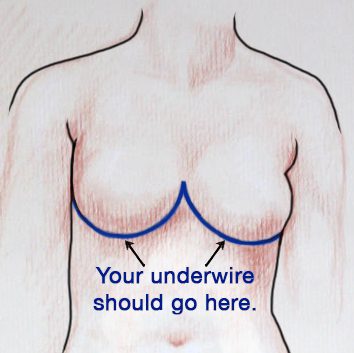
In fact, this bottom portion of bras is so often overlooked, it’s the source of the #1 most critical bra fit issue that wearers tend to miss: underwire placement at the breast base. Draw an imaginary curved line where the bottom of your breast connects to your torso, right in the crease. That junction is called the “inframammary fold” or “IMF line.” This is where your underwire should rest, directly against the breast base with no separation.

Ideally, the contour of the underwire will match the outline of your breast base so that it follows that curve from end to end. There are a few more shape factors involved with that, however, which deserve their own dedicated posts. For now, just understand that the underwire must sit flush against your breast base in order for your bra to stay properly anchored and to prevent the underwire from pressing uncomfortably into your ribs or stomach.

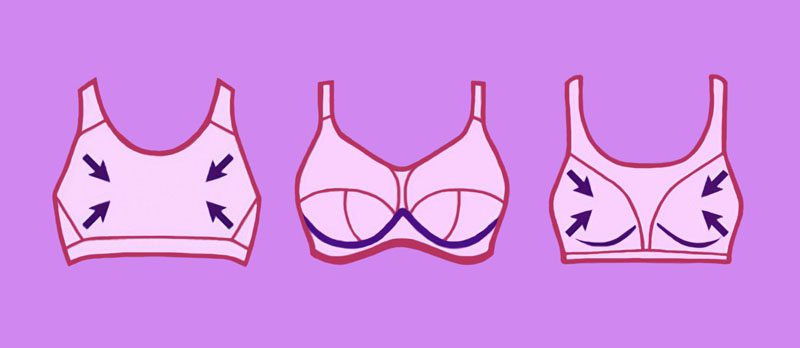
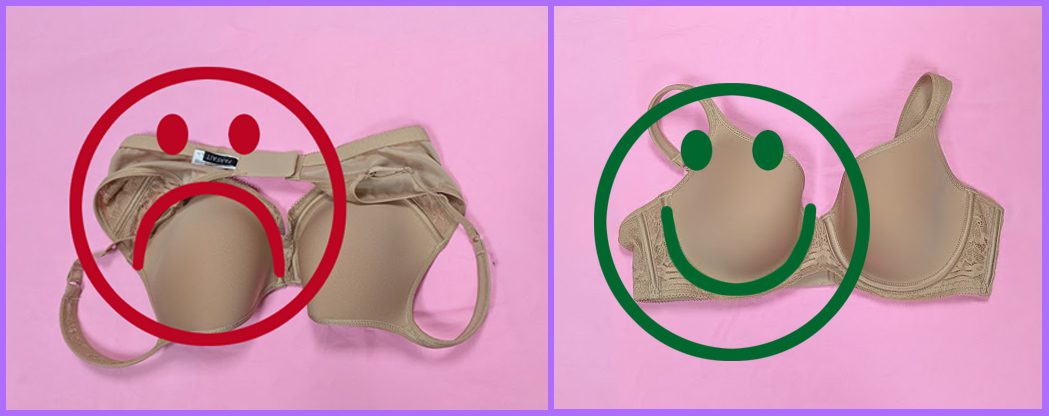
How can you tell if your underwire is riding lower than it should? If you’re evaluating the fit of your own bra, you should be able to feel it. Run your fingers along the bottom of your bra, and take note of where the wire makes contact with your torso. There are also visual indicators, which we as bra fitters watch for closely. Notice whether there is any folding or creasing of the bra cups above the underwire. There may also be bowing or deformation of the bottom portion of the cups, especially with foam-molded “T-shirt” bra styles. Check to see if the wire follows the natural curve of the IMF line.
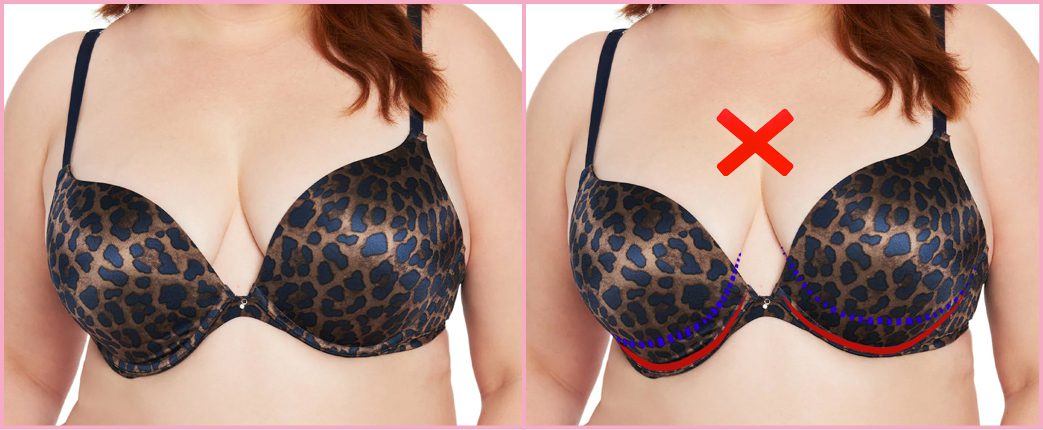


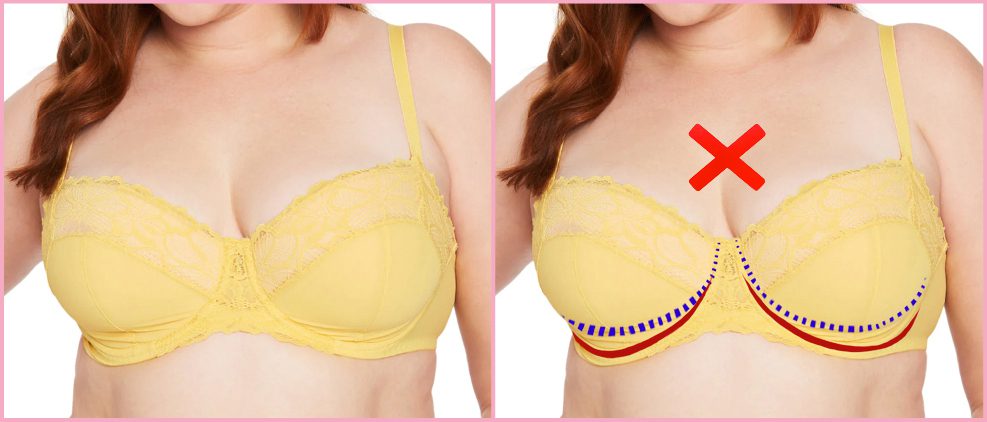
So, what happens if your underwire sits lower than it should? You may have a bit of separation between the wire and your IMF line, say a centimeter or less, or the underwire may actually be fully resting against your lower ribs. For starters, consider the size of the gap and whether or not you can feel the wire. A very small amount of separation may barely be noticeable, and in the case of new bras, may even correct itself as the bra cup material breaks in. We see this sometimes with certain Natori bras like Bliss Perfection and Cherry Blossom, for instance, that run a bit shallow in the cups but use soft materials that adapt well to the wearer. However, it doesn’t take much of a downward shift to start compromising your bra’s function and comfort. Along with the band and tacking of the gore against your sternum, a bra’s structure relies on the contact between the underwire and your torso along the length of your underbust to stabilize breast tissue. Without it, your bra has a less secure hold and will be more prone to shifting and chafing. Worse, the underwire may actually press into your ribs and stomach. Even if the bra is relatively tolerable while you’re standing, leaning forward or sitting down will cause a hinge effect where the wire is driven inwards against your body. Any time a client tells me that underwire is uncomfortable to them specifically under the breasts, I immediately suspect that this might be the cause of their distress.
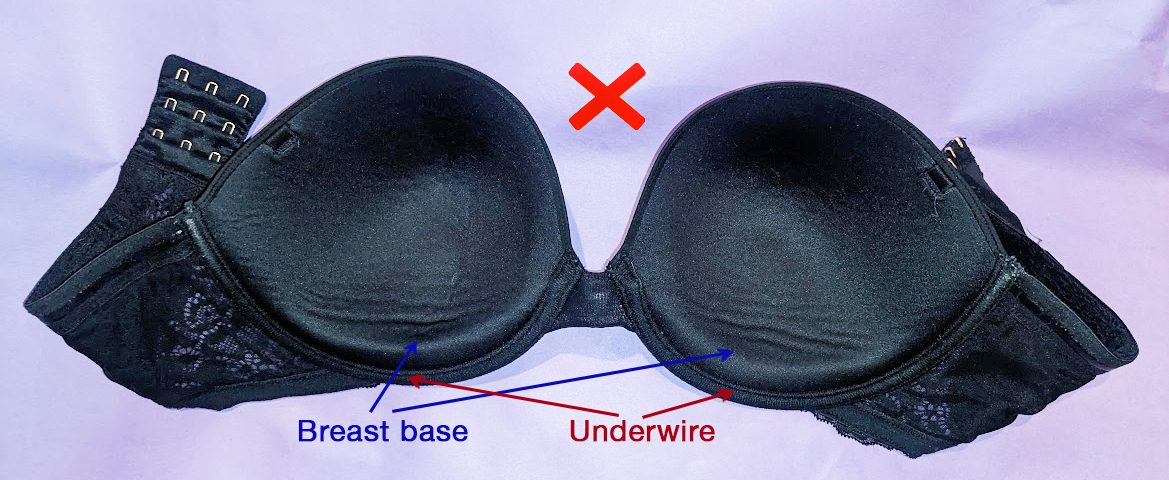
What causes a low-riding underwire, and how can it be prevented? The thing to know is that this fit problem is mainly a matter of shape, although size can play a role as well. Simply put, there isn’t enough room in the bottom of your bra cups to allow your breast tissue to settle and fill them. You may have breasts that are full-on-bottom or have a more projected shape, and the bra’s cups are too shallow or vertically sloped to align with your body contours. In fact, the weight of your breasts sitting on top of that too-shallow space at the bottom of the cups is actually pushing that wire even lower. It doesn’t mean that the bra is a “bad” bra, nor does it mean that there’s something wrong with your body (ever). It’s just a shape mismatch between the two. You probably need a bra style with deeper and/or more projected cups. That’s all. If your bra cups are too small, that will contribute to the problem of inadequate space. A larger cup size may slightly improve the situation, but 98% of the time, we’re going to need a different shape also before we really find that ideal fit.
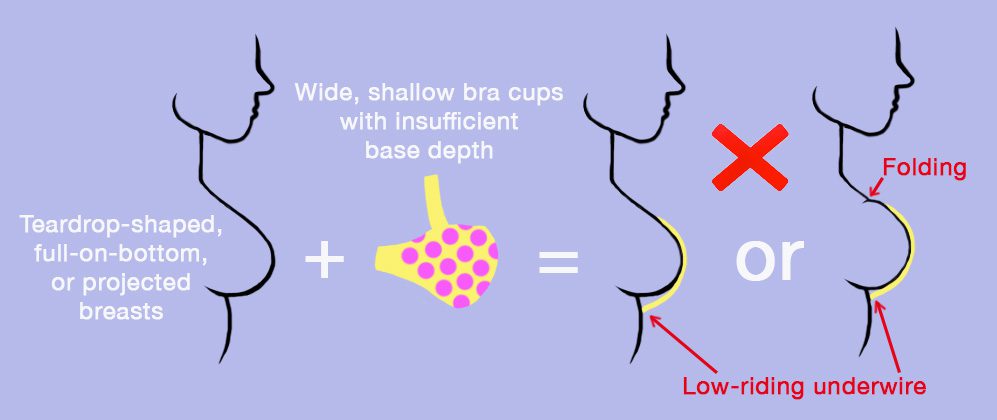
If this is brand new information to you, don’t feel bad. It’s a super common issue. Also, for some reason, a LOT of bras are made with an exaggeratedly round shape built into them, which contributes to a lot of these problems. American brands especially seem to love making wide-ish but weirdly shallow-cupped bras. This just isn’t a great shape match for most of us. T-shirt bras tend to be the worst for all of these traits, and their materials have the least amount of stretch and flex to adapt their shape to the wearer’s body. The only thing that’s trickier is padded bras. So often, these are made to literally take up the space in the bottom of the cups that is essential to a proper fit.
So there you have it. And once you know what you’re looking for…

… you’ll start seeing it everywhere. 😰 Ouch.

If you need help battling a low-riding underwire, let us connect you with some better options for your individual anatomy, wherever you fall on the size spectrum. Seriously, underwire shouldn’t hurt. If it does, there’s a problem, and we look forward to collaborating with you to find the right solution. ❤️


This is such an important fit issue that doesn’t get talked about enough. The explanation of why underwire rides low and how to fix it is really helpful. A well-fitting bra makes all the difference!