
Ah, sports bras. People love to hate them, if the goldmine of internet memes is any indication.
The animosity probably isn’t surprising, given that sports bras are easily one of the most misunderstood bra types. For starters, there’s a huge disconnect between the qualities that many people associate with “sports bras” (super stretchy, wireless, S-XL sized, pulls over your head) and the rigidly structured fit that will, y’know, actually support your chest during moderate to high-impact activities. At Grail, that’s going to be our immediate follow-up question when a customer tells us they’re looking for a sports bra… Is this client envisioning something closer to what we might call a “leisure bra,” “comfort bra,” or even a “sleep bra,” or do they need a bra for actual exercise?
The sports bras that we stock in-store are all intended for moderate or greater impact. Those comfort “sports bras” are easily obtainable in every big box store in existence, so it just makes more sense for us to focus on fit and performance. The majority of our sports bras are also bra-sized rather than alpha sized as a Small, Medium, etc. The exception would be compression-style sports bras, which I’ll talk more about later. You may be wondering, what makes a sports bra different from an everyday bra? Quality sports bras are designed to reduce breast movement even more than an everyday bra, provide a high level of support even when the wearer’s activities are forceful or jarring, and withstand this strain without falling apart prematurely. A lot of sophisticated engineering goes into sports bras, and brands can spend years on designing & wear-testing a new style before release. They’re made from durable materials and may also incorporate special textiles for moisture-wicking, temperature-regulating, or antimicrobial properties.
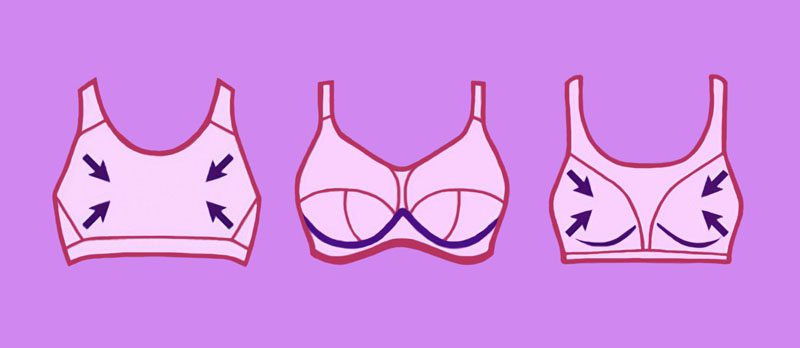
Despite sharing this specialized purpose, there is still quite a bit of variety when it comes to sports bras. Some have underwires, while others are wire-free. They may be padded or unlined. The coverage level of a sports bra will generally be moderate to high, since bounce reduction is best achieved by containing the entire breast. Technically, there is no difference between the sizing of bra-sized sports bras and that of everyday bras; however, we find that many sports bra styles run extra-snug in the band to keep everything firmly in place. There are a couple of different movement-reducing principles that designers use to build a supportive structure into their bras, which allows us to split sports bras into three primary types: Compression, Encapsulation, and Combination.
Type 1: Compression
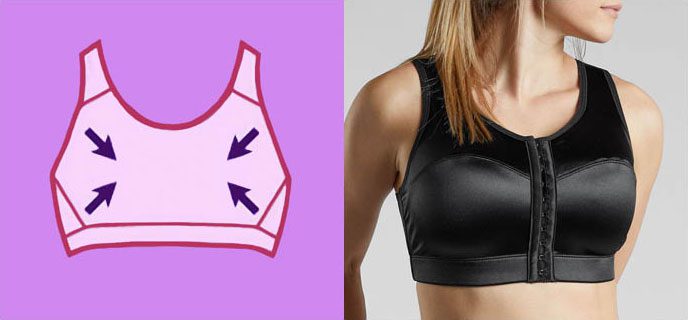
Compression sports bras reduce movement by pressing the breast tissue inward, spreading it out, and anchoring it against the wearer’s entire ribcage. The front-fastening bra pictured above is the Enell High Impact Sports Bra, one of the most effective compression sports bras on the market. SHEFIT is another popular sports bra brand that uses compression designs. Generally, compression sports bras will not be bra-sized, because they aren’t built to hold up your breasts; their purpose is to flatten them. Compression sports bras can be very effective, even for athletes with a lot of breast tissue. Unfortunately, we find that many of our clients dislike the “look” of compression, to the point that it’s a deal-breaker for them. Another downside to this sports bra category is that compressed breast tissue is pushed towards the armpits, which may cause issues with arm movement and elbow control for some wearers.
Type 2: Encapsulation:
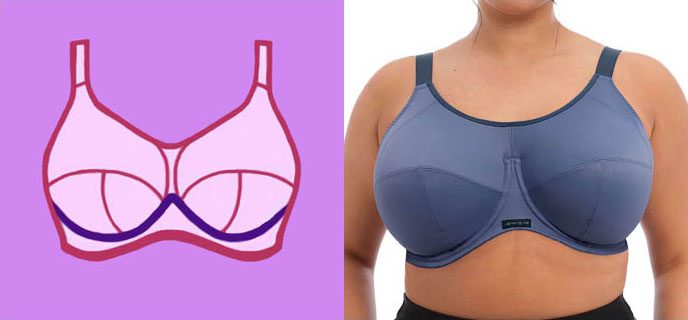
Encapsulation sports bras look closer to everyday bras because they work similarly, just with more “oomph”. Their ability to stabilize the chest is accomplished by structured cups that hold the individual breasts firmly on every surface. Encapsulation styles will always be bra-sized because they rely on a proper tailored fit to give breasts a base of support from underneath and fully contain them. The example above is the Energise sports bra from Elomi, a fan-favorite style with non-stretch unlined cups. Encapsulation sports bras are a great option for wearers across the size spectrum. They don’t have the potential to obstruct arm movement, and many of our clients find encapsulation styles to be more comfortable and figure-flattering than compression bras. If boob sweat is something that bothers you, an encapsulation sports bra (especially a wired one) will give you superior separation and breathability.
Type 3: Combination
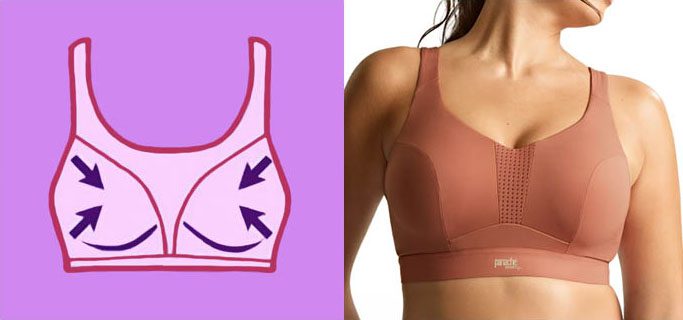
You guessed it. A “combination” sports bra does a bit of both: it has space for your breasts, but it also presses them inward a bit. The exact line between the “encapsulation” and “compression” categories is a bit fuzzy, but that’s okay; so is a lot of bra terminology. The example above is the Endurance sports bra from Panache, which holds breast tissue from the sides, the middle, and underneath, while directing gentle pressure across the whole front of the chest. Panache sports bras are excellent and well-regarded, with an independently-tested bounce reduction rate of 83%.
… Which leads me to one of the last points I wanted to make. Sadly, even the very best high-impact sports bras in current existence can’t eliminate 100% of breast movement. There are physics and structural limitations that mean some bounce is still occurring, especially for the bustier folks among us. The Grail team will keep our eyes and ears peeled for new developments in the sports bra market. (Rumor has it that a Panache bra currently in development has a bounce reduction rate of 90%. 🤞) We’re also in conversation with the Wrax brand to hopefully be one of the first shops to carry their breast bands and harnesses once they expand their sales to physical stores. (🤞🤞🤞) In the meantime, we can offer the most effective sports bras available anywhere. Unfortunately, that does not guarantee a completely stationary chest through all of your activities.
Last point: Can sports bras be worn everyday, and can “regular” bras be worn for exercise? Yes, and sorta kinda yes-ish. Plenty of people wear sports bras exclusively. Maybe they like the coverage, or the materials, or just find them more comfortable than their everyday options. There’s nothing wrong with that at all. As far as wearing traditional bras for sports or other athletic activities: your mileage may vary substantially based on your breast weight and the exact activities in question. Someone with a smaller chest doing yoga is going to have a different experience from a super-busty individual running some sort of burpee marathon. If you’re not experiencing any discomfort in your regular bras, it’s unlikely that you’re harming yourself unknowingly. I personally realized a few years ago, though, that working out in my everyday bras wasn’t a problem for me; however, my bras were starting to show signs of damage as a result of my activities (lots of Judo breakfalls). Good bras aren’t cheap, and I didn’t want to keep subjecting my favorites to that sort of abuse. I switched to non-wire Evelyn & Bobbie bras for sports, and I haven’t looked back.
The best sports bra options for you will depend on your size, shape, and personal preferences… just like any bra. 😊 If you need help, we’re here to collaborate with you on solutions!




0 Comments