

One of the most frequently-repeated messages on this blog and in the Grail fitting rooms is: Bra cup sizes don’t work the way that most people think they do. Whether it’s an A, a C, a DDD, or any other size, cup letters have no designated volume on their own. Cup volume scales smaller or larger depending on the bra’s band size. This leaves a huge lingering question, however… If almost everyone’s concept of bra sizes is wrong, why?
I know that for some of our clients, it must feel jarring to be told that “A = extra small, B = small, C = medium, D = large, DD and DDD = the absolute largest boobs imaginable” is just entirely false. This is how their mothers, sisters, cousins, friends, movies & TV shows, and an endless stream of traditional media and social media have talked about bra sizes their entire lives. Now some bra fitter is telling them that their very average-sized breasts are a 32H, and they’ve never even heard of an H-cup…? It can be difficult to believe. Surely the entire world isn’t experiencing some mass delusion where everyone collectively hallucinated a nonexistent bra sizing scale? There’s an explanation, though! These conventional ideas about the size of A – DDD bra cups aren’t made up out of thin air; they’re just outdated.
The history of the bra is long and complex. Women have bound their breasts since before written records, and bra-like garments existed at least as far back as the 1400s. Precursors to the modern bra emerged in the late 1800s as an alternative to corsets. Additional innovations (and the demands of World War I) sped the adoption of bras in the 1910s and 20s. However, bra cup sizes didn’t enter the scene until the 1930s. Older bras didn’t differentiate between breast volume and the overall size of the chest. The Warner’s brand was the first to popularize letter-sized bra cups with their A, B, C, and D-sized Alphabet Bra in 1935.

In the decade that followed, a rough approximation of a sizing system began to take shape. Numerical band sizing was adopted in the United States following World War II, but that number corresponded to the full bust circumference rather than the ribcage below the breasts. Cup sizes A through D were used subjectively to refer to busts of various, well, bustiness. Does this sound familiar? For simplification purposes, we’ll call this Vintage Sizing, but it’s important to realize that at this time, there was truly no standardization between bra makers (not even an imperfect attempt at consistency). Bra sizes, especially bra cup sizes, weren’t objectively defined. An A-cup, or a B, or a C was as large as the brand decided that an A, B, or C-cup should be.

If this sounds kind of messy and imprecise, it was. In fact, by 1975, the European Common Market decided that change was necessary to create a universal & objective bra sizing system that was predictable and consistent across bra makers. They passed new regulations defining that (1) the number portion of a bra’s size corresponds to the wearer’s underbust circumference, and (2) the cup letter indicates the number of inches between the underbust and the widest part of the bust. This created Modern Bra Sizing, the system that’s still in place today.
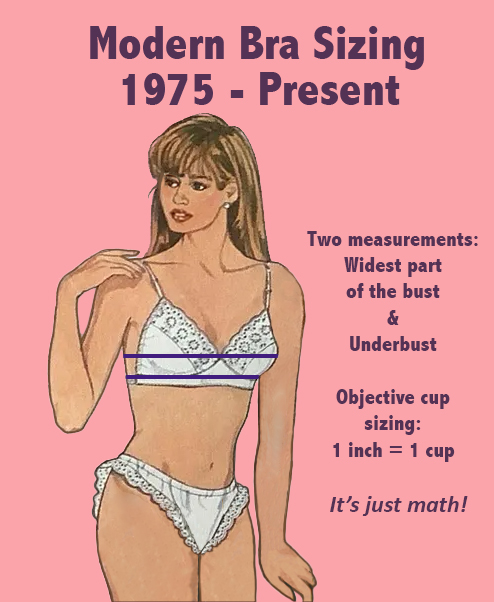
Problem solved, right? Unfortunately, these changes were pretty unpopular with many bra wearers and bra retailers when they were enacted. Some women at the time took pride in their bra size as part of their identity (we still see this phenomenon among our clients at Grail) and had negative associations with their new sizes under the updated system. For bra makers and sellers, the new sizing standards required a size range expansion beyond the original four cup letter sizes. More sizes would mean more development costs, more inventory items to stock, and additional expenses for those businesses.
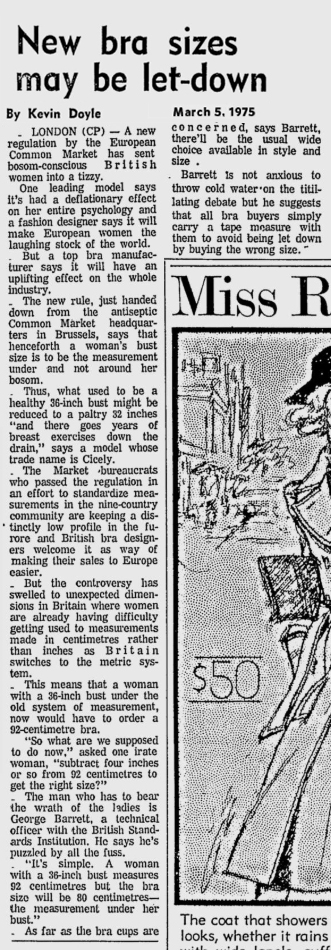
It was during this period of the mid-to-late-1970s that “legacy sizing” or “+4 sizing” gained a foothold, in which bras were manufactured according to the new regulations, but women were sized by retailers into bands four or five inches larger than their ribcages. This practice put wearers into sizes that sounded more like their vintage sizes, although unfortunately, it also pretty much guarantees a poor fit. More on that subject another time.
So, these popular notions of “A = extra small, B = small, C = medium, D = large, DD and DDD = Tits McGee & Chesty LaRue” are just holdover ideas from the vintage sizing era. The thing is, modern bra sizing has been around for over 50 years now.

It’s kind of amazing that these size associations with cup letters have been so persistent! Who would have thought that a bra sizing system older than the entire Star Wars franchise would still be causing so much confusion and distress today? Modern sizing isn’t perfect; it’s a huge improvement over vintage sizing, however, because it’s objective, based on actual body proportions, and inclusive of the entire size spectrum. Don’t let antiquated ideas about bra sizing be an obstacle in your search for a better-fitting bra.

0 Comments